
Self-Paced vs Classroom ISO Training in the Gulf: Cost, Time, and Recognition Compared
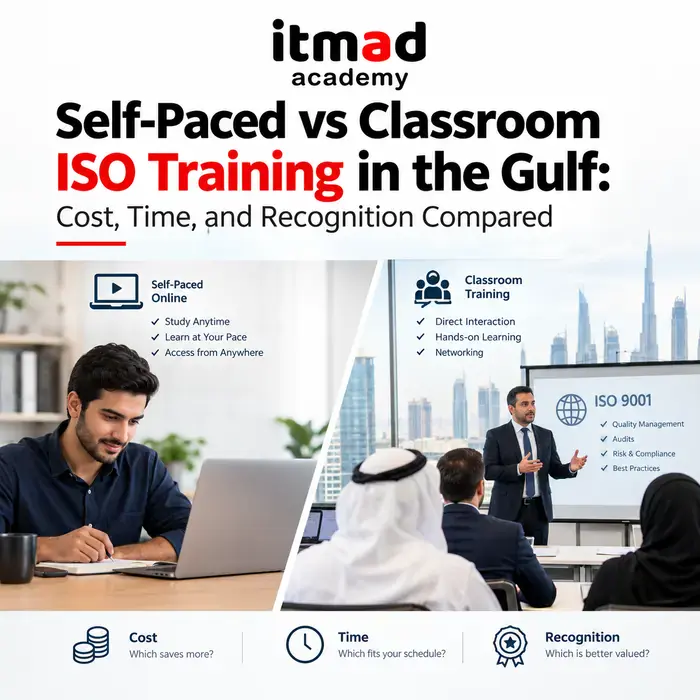
For most GCC quality, HSE and compliance teams, self-paced ISO training is the lower-cost, more flexible choice, because it removes travel and fixed course dates and lets people study around shifts. Classroom training suits learners who want live discussion with a trainer, or whose employer requires it. Recognition depends on the accreditation behind the course and on who needs to accept the certificate, not on the delivery format alone. This guide compares cost, time and recognition in tables, shows real Itmad Academy prices and hours, and lists what to check before you book either option.
Self-paced vs classroom at a glance
| Factor | Self-paced online | Classroom |
|---|---|---|
| Cost | Course fee only | Course fee plus travel, accommodation and meals if away from base |
| Time away from work | None; study in short sessions | Fixed days off the job |
| Schedule | Start any day | Set course dates |
| Pace | Your own | The group's |
| Live interaction | Limited to support channels | Direct, with trainer and peers |
| Revisit material | Lifetime access to enrolled courses at Itmad Academy | Depends on the provider |
| Best for | Busy teams, shift workers, multi-site groups | Learners who want face-to-face practice |
Read the table by role, not by company. A site coordinator who audits twice a year, a lead auditor who runs a programme, and a manager who only needs awareness will not always need the same format. Matching format to role is usually where teams save the most time and money.
Cost: compare the total, not the course fee
A classroom course fee is only part of the bill. Before you compare, add every line below for each person.
| Cost line | Self-paced | Classroom |
|---|---|---|
| Course fee | Listed price | Quoted price |
| Travel and accommodation | None | Add per person |
| Days away from work | None | Days multiplied by daily staff cost |
| Rescheduling if work changes | Study later, no extra fee | Ask the provider |
Real self-paced prices: ISO 9001 as an example
These are the listed prices of the four ISO 9001 courses on the ISO 9001 standard page on 26 October 2026, with the course hours shown there.
| Course | Hours | Listed price |
|---|---|---|
| Foundation | 6 hours | 125 AED |
| Internal Auditor | 16 hours | 350 AED |
| Lead Auditor | 40 hours | 1,200 AED |
| Implementer | 24 hours | 1,200 AED |
To compare, ask a classroom provider for a written quote for the same level, then add travel, accommodation and lost working days from the table above.
Training a team: one fixed fee
When several people need several courses, a license can lower the cost further. Itmad Academy's Business license is 10,000 AED for up to 5 learners and any 25 courses. Five people taking all four ISO 9001 courses cost 14,375 AED if bought one by one (2,875 AED each), against 10,000 AED on the license. Seats are fixed to named learners. See the license page and the current promotions.
Time: hours are the same, scheduling is not
Hours of learning are set by the content, so the real difference is how the time is spent.
- Self-paced: the 40-hour ISO 9001 Lead Auditor course can be split into short sessions over several weeks, around inspections, shifts and audits.
- Classroom: learning is packed into set days, so the whole group is away from work together. That can disrupt cover for sites and shifts.
- Catch-up: if someone misses a classroom day, the provider decides what happens next. In a self-paced course, you simply resume the lesson.
How a self-paced course works day to day
Each learner receives login details for the learning platform at my.itmadacademy.com, where enrolled courses and certificates are kept. Courses run on phone, tablet and laptop, and progress is saved to each learner's own account. Lifetime access means a learner can return to a lesson months later, for example before an audit, without paying again.
Recognition: what really matters
Employers and clients rarely care whether a course was online. They care who stands behind the training. Itmad Academy's accreditations page explains that accreditation applies to the training content and assessment, not the delivery format, and that self-paced learners cover the same requirements and pass the same assessment. Itmad Academy's training is approved by Exemplar Global (USA), whose training provider certification looks at the design, development and delivery of a course framework.
Four checks before you book any format
- Name the accreditation body. It should be printed on the certificate, not just the website.
- Verify the certificate. A working verification link means an employer or client can check it. Itmad's is on the certificate verification page.
- Ask your end user. Check whether your employer, client, tender or certification body accepts online delivery for the role.
- Separate training from personnel certification. Registering as a certified auditor is a separate application with its own rules. Our Exemplar Global vs IRCA vs PECB guide and our guide to verifying auditor certificates explain the difference.
Common mistakes when comparing
- Comparing only the course fee. Travel, accommodation and days away from work can change the ranking.
- Skipping the recognition check. Ask the people who will accept the certificate before you pay, whichever format you choose.
- Choosing one format for every role. Awareness, internal audit and lead auditor needs differ, and so can the best format.
- Ignoring the team angle. One person's price per course tells you little about the cost of training ten.
Which format fits your situation?
| Choose self-paced if | Choose classroom if |
|---|---|
| People work shifts or across several sites | Your employer or client requires live delivery |
| You are training a whole team on a budget | Learners want face-to-face group exercises |
| You need to start now, not on a set date | The team can all be released for the same days |
| You want to revisit lessons later | You prefer one trainer for questions on the spot |
Many teams combine both: self-paced foundation and internal auditor courses for most staff, and a classroom or live option only where a specific role needs it. Browse the course catalogue or pick your standard on the standards page. The wider Itmad group is described on itmad.ae.
Frequently asked questions
Is self-paced ISO training as valid as classroom training?
According to Itmad Academy's accreditations page, accreditation applies to the training content and assessment, not the delivery format. Whether a specific employer or scheme accepts it is their decision, so confirm before you enrol.
Is online ISO training cheaper than classroom training?
Usually it avoids travel, accommodation and days away from work. Compare the full cost, as in the cost table above, using written quotes for classroom options.
How long does self-paced training take?
It depends on the course. The ISO 9001 courses are listed at 6, 16, 24 and 40 hours. You decide how to spread them over days or weeks.
Can a whole team train online at the same time?
Yes. A team license enrols named learners on their own accounts, and each person's progress is saved separately. Up to 10 learners are covered by the Corporate plan, and larger teams can request a custom plan.
Does a training certificate make me a certified auditor?
No. Training and personnel certification are separate steps. Check the certification body's own requirements for the scheme you want.
Choose the format that fits your team
Add up the full cost, check what your employer will accept, and then pick the format. If self-paced fits, request a team license and Itmad Academy will reply within one business day, or start with the ISO courses.