
How to Verify an ISO Auditor Certificate: A Guide for GCC Employers
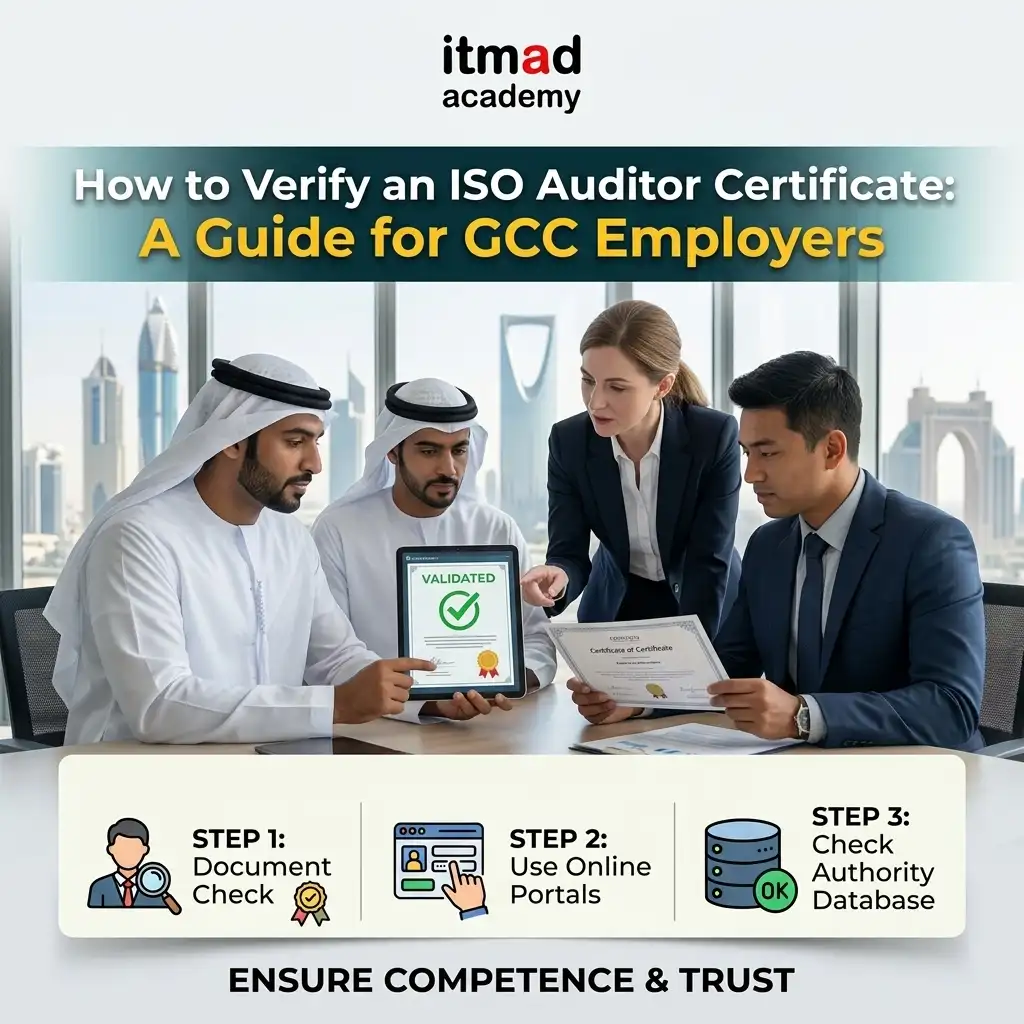
To verify an ISO auditor certificate, check four things in order: who issued it, whether its details match the person in front of you, whether the issuer confirms it through its own verification channel, and whether the course and certification body behind it are genuinely accredited. A genuine certificate passes all four checks in minutes, while a weak one usually fails at the first. This guide gives GCC employers a practical, repeatable process for quality, HSE and compliance hires, so your due diligence is fast, consistent and defensible.
1. Why verification matters
1.1 The business risk
Auditors shape decisions. Their findings influence supplier approvals, certification outcomes and corrective-action priorities. If the person holding the clipboard is not who their paperwork says they are, the whole audit trail is exposed.
- Credibility: a client or certification body can reject audit evidence produced by an unqualified auditor.
- Cost: repeating an audit, or replacing a hire, is far more expensive than a few minutes of checking.
- Reputation: one weak credential found late can put the trust you built with customers at risk.
1.2 Certificate versus certification
Before you check anything, be clear about what you are checking. A course certificate shows that someone completed approved training. A personal auditor certification or registration is a separate credential, awarded by a certification body after the person meets its criteria. Many roles need one, the other, or both, so decide which one your requirement names before you start.
2. The four-step check
Run these steps in order. Each takes minutes, and together they give you a routine you can repeat for every hire, contractor and supplier auditor.
2.1 Step 1: Identify the issuer
Start with who actually issued the document. A certificate with no clear issuer is a problem before you read another line. Look for:
- The name of the training provider or certification body
- The certificate number or unique reference
- The issue date, and an expiry or renewal date where one applies
- A QR code or verification link you can follow
2.2 Step 2: Match the details
Next, compare what the certificate says with what you were told.
- Name: it should match the candidate's official ID exactly.
- Course and standard: for example ISO 9001, ISO 14001 or ISO/IEC 27001, at the level claimed, such as internal auditor or lead auditor.
- Edition: several ISO standards are moving to new editions, so check that the course covered the version your organisation audits against.
- Dates: they should fit the candidate's work history and the course length.
2.3 Step 3: Confirm with the issuer
A certificate that looks right still has to be confirmed by the people who issued it. Use the issuer's own verification channel, not a link or email supplied by the candidate.
- For Itmad Academy certificates: enter the certificate details on the Verify Certificate page, which opens in a new tab.
- For personal certifications: ask for the certification or registration number, then check it through the certification body's own channels.
- If there is no online option: email the issuer's official contact, using details from its own website, and ask for written confirmation.
2.4 Step 4: Check the accreditation behind it
Finally, ask who stands behind the issuer. A provider can say it is accredited, but the claim only counts if the named body confirms it.
- Find the accreditation body named on the certificate or the provider's website.
- Look the provider up in that body's own directory, where one is published.
- Confirm the approval covers the specific course and scheme, not just the provider in general.
Itmad Academy can be checked in the directories of the respective accreditation bodies, and the approvals we hold are listed on our accreditations page.
3. Verifying by scheme
The schemes we see most often in GCC job adverts work differently, so know what to ask for before you start.
3.1 Exemplar Global
- Ask for the individual's certification number and the certification title.
- Check the details with Exemplar Global directly.
3.2 IRCA
- Ask for the registration number and the auditor grade claimed.
- Check the details through IRCA and its parent body's site.
3.3 PECB
- Ask for the certificate number and the exact certification title.
- Check the details with PECB directly.
4. Red flags to watch for
If a certificate doesn't pass the sniff test, treat it as unverified until proven otherwise. It isn't legit until the issuer says so. Common red flags:
- No certificate number, or a number the issuer cannot find
- No QR code or verification link, and no way to contact the issuer
- A generic template with no clear issuer or accreditation body named
- Vague claims such as "internationally accredited" with no body named
- A name, standard or level that doesn't match the candidate's story
- Inconsistent fonts, spacing or logos that suggest the document was edited
- A provider that is unreachable when you try to confirm
One red flag is a reason to ask questions, not proof of fraud. Many are simple paperwork gaps, so ask first and decide after.
5. Building verification into hiring and procurement
Verification works best as a routine, not a one-off scramble. A simple process:
- Ask early. Request the certificate and ID number at the application or tender stage.
- Verify before you commit. Complete the four-step check before an offer or contract is signed.
- Keep a paper trail. Save a copy of the certificate and note the date, the channel and who checked it.
- Re-check at renewal. Credentials expire or lapse, so check again at recertification or contract renewal.
- Write it into your documents. Put the requirement in job descriptions, supplier requirements and tender documents so everyone knows the standard up front.
6. Where Itmad Academy fits
Itmad Academy training is approved by Exemplar Global, and Itmad is the authorised PECB partner in the UAE. Each certificate we issue carries a unique verification link and QR code, so your team gets the same paper trail we recommend you ask of everyone else.
7. Frequently asked questions
What is the fastest way to verify an ISO auditor certificate?
Use the issuer's online verification page where one exists, then confirm the accreditation behind it. Most of the time goes on chasing documents, so ask for the certificate number up front.
What if the issuer has no online verification?
Email the issuer's official contact, using details from its own website, and ask for written confirmation of the name, certificate number and course.
Does a verified course certificate prove someone is a certified auditor?
Not by itself. It proves that training was completed. A personal certification or registration is a separate credential from a certification body, so verify that one separately if your role requires it.
How do I verify an Itmad Academy certificate?
Use the Verify Certificate page linked in step 3 and enter the certificate details. Itmad can also be checked in the directories of the respective accreditation bodies.
How often should we re-check certificates?
At renewal, at recertification and whenever the scope of the work changes, for example a new standard or a more senior audit role.
8. Your next step
Pick one role you are hiring for, or one supplier you rely on, and run the four-step check today. If your team needs auditor training with a certificate you can verify, browse our ISO auditor courses and choose the standard and level that fit.