
ISO 14001 2026 Revision: What Changes and What Auditors Need to Know
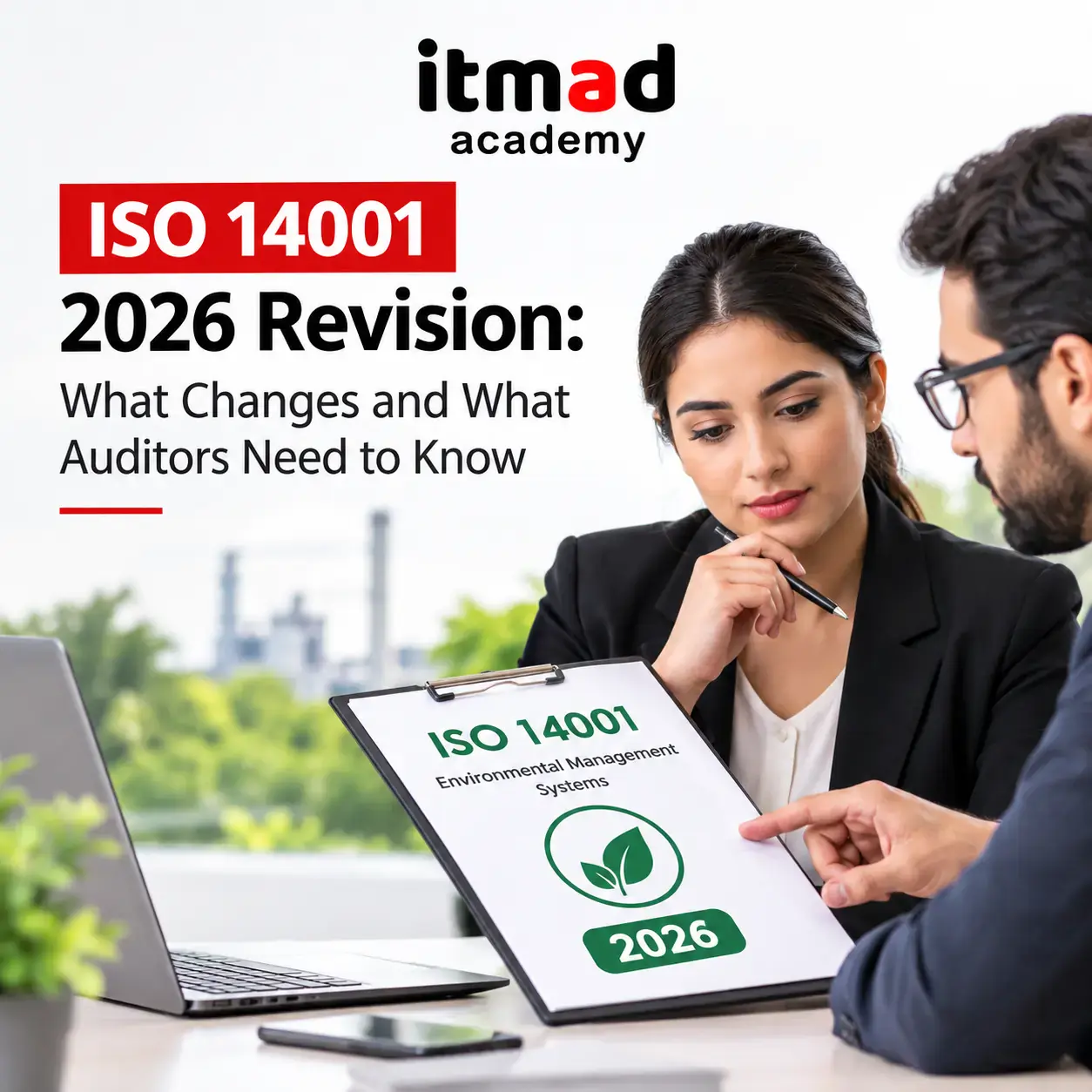
ISO 14001:2026 replaces the 2015 edition of the environmental management system standard. It was published on 15 April 2026, and the changes are moderate: most clarify existing requirements rather than add new ones. The main updates are climate change in the organization's context, a new clause 6.3 on planning of changes, a stronger life cycle focus and wider supply chain controls. Certificates to the 2015 edition have a 36-month transition, to 30 April 2029 at the latest. For auditors, the job now is to update checklists and audit programmes. This guide sets out the changes, what to check, and the cheapest way to train a team.
ISO 14001:2015 vs ISO 14001:2026 at a glance
| Topic | ISO 14001:2015 | ISO 14001:2026 |
|---|---|---|
| Status | Withdrawn | Published 15 April 2026 |
| Climate change (clause 4.1) | Added later by Amendment 1:2024 | Built into the standard |
| Other conditions in context | Not named | Pollution, biodiversity, natural resources |
| Planning of changes | Inside clause 8.1 | New clause 6.3 |
| Supply chain controls | Outsourced processes | Externally provided processes, products and services |
| Life cycle perspective | Included | Stronger emphasis |
| Documented information | "Retain" and "maintain" | Available when needed, in any format |
| Annex A guidance | Shorter | Extended |
Sources: ISO's ISO 14001:2015 page, which shows the 2015 edition as withdrawn and replaced, and DQS's revision summary. DQS notes there are no fundamentally new requirements; check clause wording against the published standard.
Timeline: from draft to deadline
| Date | Milestone |
|---|---|
| June 2025 | Draft International Standard (DIS) published |
| January 2026 | Final Draft International Standard (FDIS) published |
| 15 April 2026 | ISO 14001:2026 published |
| 30 April 2029 | Last date to transition existing certificates (36 months) |
Draft dates come from DEKRA's revision page. Your certification body decides how and when it schedules transition audits, so ask it for your date.
What stays the same
The revision is evolutionary, so the core of an environmental management system is unchanged:
- Plan, do, check, act: the same management cycle underpins the standard.
- Environmental aspects and compliance obligations: still the base of your planning.
- Internal audit and management review: still required to show the system works.
- Certification: ISO 14001 remains the standard organizations are audited against by an independent certification body.
In practice, a well-run 2015 system needs a focused update, not a rebuild. The gap review in the steps below shows where the work is.
What auditors need to know
1. Update your checklists and audit programme
The standard now follows the Harmonized Structure more closely, and some subclauses are new or restructured. An audit checklist built on the 2015 text will miss new items. Rebuild it from the 2026 text, not from memory.
2. Check climate and environmental conditions in context
Clause 4.1 now expects the organization to consider climate change as a possible external issue, with pollution, biodiversity and natural resource availability named too. Ask how the organization decided what is relevant, and what evidence it kept.
3. Look for planned changes
Planning of changes has its own clause (6.3). Ask for examples: a new site, process, product or supplier. Check who approved the change and how environmental effects were assessed beforehand.
4. Test controls over suppliers
Operational controls now cover externally provided processes, products and services, not only outsourced processes. Sample contractors, waste carriers and material suppliers, and check that controls match the environmental aspects.
5. Follow the life cycle thinking
Auditors should look beyond the site boundary: design, purchasing, delivery, use and end of life where the organization has influence.
Why this matters for GCC teams
Many GCC organizations run quality, health and safety and environmental systems side by side, often across several sites or countries. A revision that follows the Harmonized Structure more closely makes it easier to align ISO 14001 with ISO 9001 and ISO 45001 audits. Clients, tenders and group head offices may also ask for evidence that your team understands the new edition . A trained internal audit team is the simplest way to show that.
Which course fits which role?
| Level | Best for | Listed price |
|---|---|---|
| Foundation | Staff who need to understand the new requirements | 125 AED |
| Internal Auditor | Site coordinators and HSE officers who audit the system | 350 AED |
| Lead Auditor | People who lead audit programmes or audit suppliers | 1,200 AED |
| Implementer | Managers who update and run the system | 1,200 AED |
Prices are the listed prices of the four ISO 14001:2026 courses on the ISO 14001 standard page on 24 October 2026. Browse all options on the standards page or the course catalogue. Training is Exemplar Global approved; see the accreditations page.
One fixed fee vs paying per course
| Plan | Fixed fee (AED, excl. VAT) | Learners | Courses |
|---|---|---|---|
| Individual | 5,000 | 1 | Any 10 |
| Business | 10,000 | Up to 5 | Any 25 |
| Corporate | 15,000 | Up to 10 | Any 50 |
| Your team | Pay per course | Team license | Better value |
|---|---|---|---|
| 1 person, Foundation and Internal Auditor | 475 AED | 5,000 AED | Per course |
| 5 people, all four ISO 14001 levels | 14,375 AED | 10,000 AED (Business) | License |
| 10 people, Internal and Lead Auditor | 15,500 AED | 15,000 AED (Corporate) | License |
The totals use today's listed ISO 14001 prices (125 + 350 + 1,200 + 1,200 = 2,875 AED per person). With a license you also keep spare courses for ISO 9001 or ISO 45001, and every enrolled course has lifetime access. Seats are fixed to named learners and cannot be reassigned. See the license page and check the promotions page before you decide.
Your next steps
- Ask your certification body for your transition date and audit plan.
- Run a gap review of your EMS against the 2026 text, starting with clauses 4.1 and 6.3.
- Train the right people: Foundation for awareness, Internal Auditor for audits, Lead Auditor and Implementer for owners.
- Update audit checklists and brief the audit team before the next cycle.
Itmad also provides certification, inspection and auditing services; the group is described on itmad.ae. Exemplar Global shares guidance for trainers in What Trainers Should Know About ISO 9001 and ISO 14001 Revisions.
Frequently asked questions
Is ISO 14001:2015 still valid?
ISO lists the 2015 edition as withdrawn and replaced by ISO 14001:2026. Existing certificates remain valid during the transition period, which ends on 30 April 2029 at the latest, according to DQS. Confirm your own date with your certification body.
Is the 2026 revision a major rewrite?
No. DNV describes the extent of change as moderate, and DQS says it mainly clarifies existing requirements. The biggest items are climate in context, clause 6.3 and supplier controls.
Do internal auditors need new training?
They need to know what changed. A current ISO 14001:2026 internal auditor course covers the new text, and a foundation course is enough for staff who only need awareness.
Is a team license cheaper than buying courses one by one?
It can be. In the example above, five people taking four courses each cost 14,375 AED per course against 10,000 AED for a Business license. For one person taking two courses, per-course is cheaper.
Is Itmad Academy's training accredited?
Itmad Academy's training is approved by Exemplar Global (USA). Each certificate can be checked on the certificate verification page. Training does not certify your organization.
Update your team's ISO 14001 skills now
List who needs which level, compare the total with a license, and choose the cheaper route. Request a team license and Itmad Academy replies within one business day, or start with the ISO 14001 courses.