
ISO 27001 for Banks and Fintech in Kuwait and Qatar: Why Certified Auditors Are in Demand
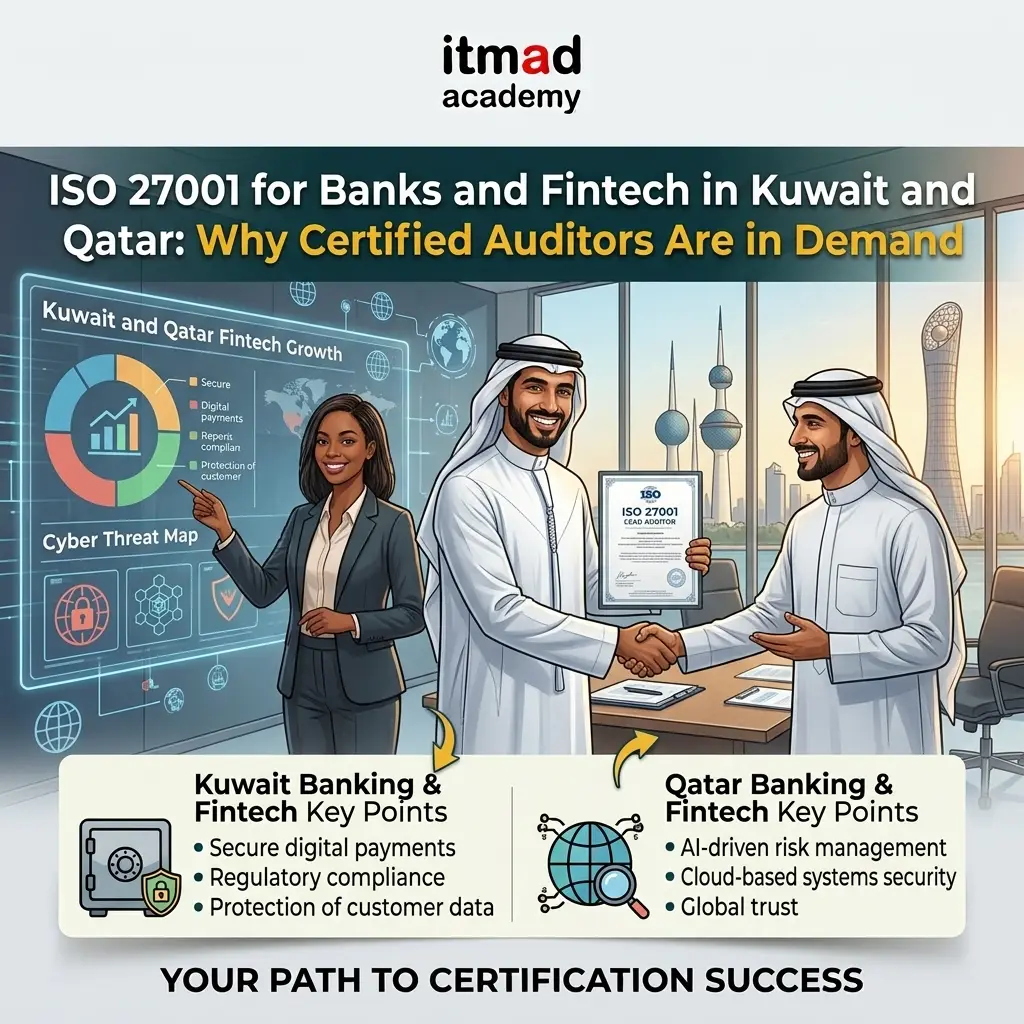
Certified ISO 27001 auditors are in demand at banks and fintech firms in Kuwait and Qatar because these organisations must show that their information security controls work, not just that they exist. ISO 27001 itself requires internal audits, financial regulators in both countries have recently published cybersecurity or data-protection expectations, and partners often ask for independent assurance. Together, that creates a need for people who can plan and run an audit against the standard. This guide explains the reasons, what the regulators have said so far, and which ISO 27001 course to take first.
Why audits matter as much as controls
Building controls is only half the job. An information security management system (ISMS) under ISO/IEC 27001 has to be checked to show it works. That is where auditors come in.
- Internal audits are part of the standard. ISO 27001 expects organisations to audit their own ISMS at planned intervals.
- Management needs evidence. Boards and risk committees want to know the controls work, and audit findings give them evidence.
- Third parties need assurance. Banks and fintech firms rely on cloud providers, payment processors and other suppliers, and each one is a risk that someone has to assess.
- Certification is a cycle. An organisation certified to ISO 27001 is audited by its certification body on a recurring basis, so internal audits and corrective actions have to keep pace.
None of this is specific to one country, but it explains why audit skills sit close to the centre of a financial institution's security programme.
What regulators in Kuwait and Qatar have said
None of the coverage we reviewed says ISO 27001 is mandatory. It does show regulators raising expectations on security and data, which is the context auditors work in.
Kuwait
On 11 December 2025, a news summary reported that the Central Bank of Kuwait unveiled a comprehensive cyber and operational resilience framework, described as the primary regulatory guideline for local banks and financial institutions in Kuwait. Read the news summary. The coverage we reviewed did not give a deadline or detailed requirements, so check the Central Bank of Kuwait's own documents for the details.
Separately, the Central Bank of Kuwait announced in July 2021 that it had maintained ISO/IEC 27001:2013 certification for its own information security, covering human resources, technical and information centres. See the press release. That was the 2013 edition, and it describes the central bank's own certification, not a requirement on banks.
Qatar
In February 2025, Gulf Times reported that Qatar Central Bank issued a Data Handling and Protection Regulation for financial institutions in Qatar, covering governance, customer protection, data security, business continuity and disaster recovery. Read the report. The article does not mention ISO 27001, audits or certification, and it gives no effective dates, so read the regulation itself for the requirements that apply to you.
What this means for ISO 27001
ISO 27001 is a voluntary international standard. What it gives a bank or fintech firm is a recognised structure for governance, risk assessment and controls, plus an audit routine that produces evidence. When a regulator, a customer or a partner asks how you know your controls work, an audited ISMS is a strong answer. Whether ISO 27001 is expected for your licence type is a question for your regulator.
What an ISO 27001 auditor does
An ISO 27001 auditor checks whether an organisation's ISMS meets the standard and works in practice. Typical work includes:
- Planning audits and agreeing scope with the people being audited
- Reviewing risk assessments, the statement of applicability and control evidence
- Interviewing staff and sampling records, tickets and logs
- Reporting findings clearly and tracking corrective actions to closure
- Leading the audit team and the closing meeting, if you are the lead auditor
The skill is not only technical. Auditors need to ask good questions, stay objective and explain findings in language that management can act on.
Which ISO 27001 course should you take first?
Itmad Academy offers four ISO 27001:2022 courses, all 100% online and self-paced. Hours are as listed on our course pages. You can see them together on the ISO 27001 courses page.
- Foundation (6 hours): for compliance and risk staff who need the vocabulary and the structure of the standard.
- Internal Auditor (16 hours): for people who audit their own organisation's ISMS, such as internal audit, risk and IT assurance teams.
- Lead Auditor (40 hours): for audit leads, consultants and anyone who leads audits or reviews suppliers. See the ISO 27001 Lead Auditor course.
- Implementer (24 hours): for the people who build the ISMS and prepare for audit.
The internal auditor and lead auditor courses are listed with Exemplar Global approval, and you can see the approvals we hold on our accreditations page. A course certificate shows that you completed training. A personal auditor certification is a separate credential, so check which one your employer or client requires.
Building audit capability inside a financial institution
For a bank or fintech firm, a sensible approach is to grow audit skills in stages instead of relying on a single expert.
- Start with a small core team. Train a few people from compliance, risk and IT so that audits do not depend on one individual.
- Keep audits independent. Auditors should not audit their own work, so spread audit duties across teams.
- Plan the audit programme. Cover the whole ISMS over a cycle, and give higher-risk areas such as payments, access control and suppliers more attention.
- Close the loop. Track every finding to a documented fix, and re-check it at the next audit.
- Add lead auditors as you grow. When you audit suppliers or run a larger programme, a lead auditor can coordinate the team and report to management.
Check the edition
The official ISO page for ISO/IEC 27001:2022 lists the 2022 edition as current and shows the 2013 edition as withdrawn. It also lists a 2024 amendment on climate action changes. Make sure any course you choose covers the 2022 edition. Ours are titled ISO 27001:2022.
Common mistakes to avoid
- Assuming ISO 27001 is mandatory. Check what your regulator and customers actually require before you decide.
- Training only the implementers. An ISMS needs people who can audit it as well as build it.
- Confusing a course certificate with a personal certification. They are different credentials with different requirements.
- Using the old edition. Confirm that training and documents refer to the 2022 edition.
- Treating audits as paperwork. The value is in findings that lead to real fixes.
Frequently asked questions
Is ISO 27001 mandatory for banks in Kuwait or Qatar?
None of the coverage we reviewed says so. Requirements depend on your regulator and licence type, so check with the Central Bank of Kuwait or Qatar Central Bank directly.
Do fintech firms need ISO 27001 certification?
It depends on your regulator, your customers and your partners. Many fintech firms adopt it because it gives a recognised structure and audit evidence, but whether it is expected for your business is a question to confirm locally.
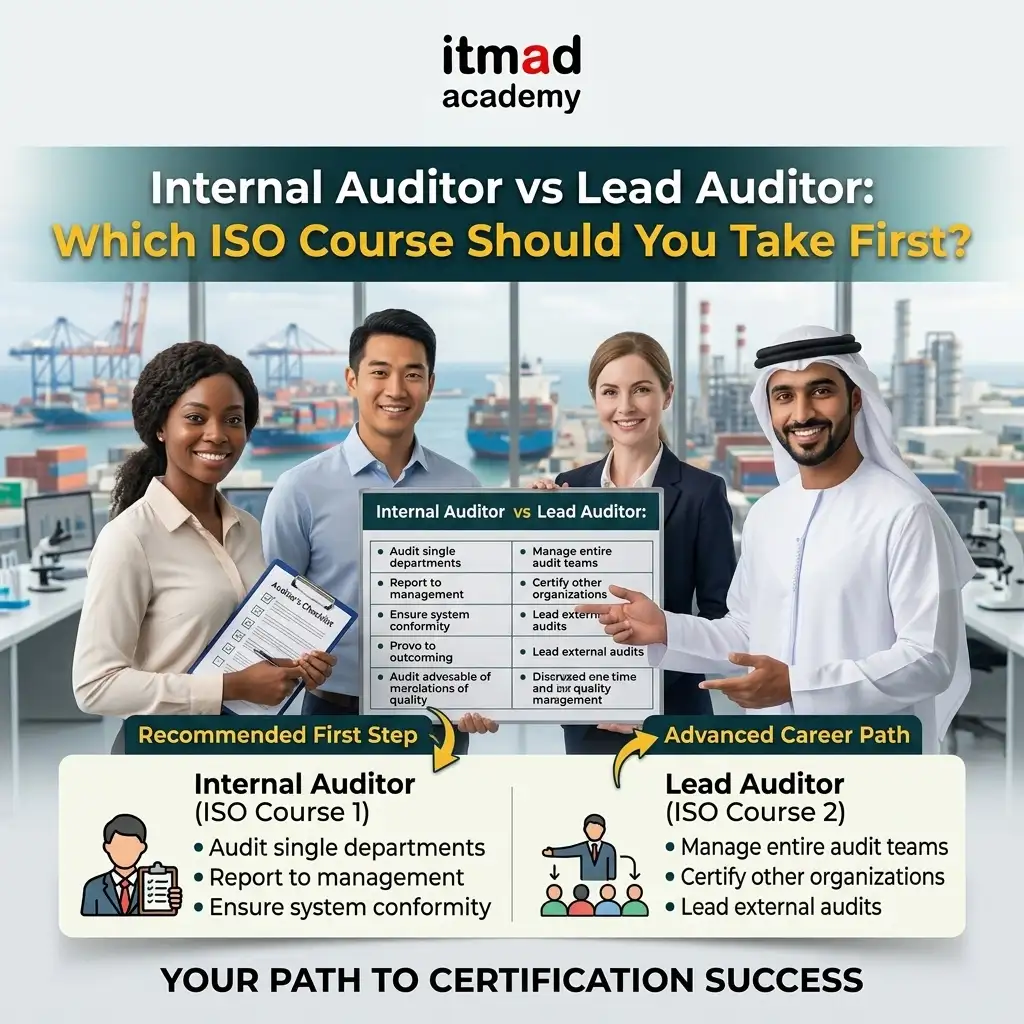
What is the difference between an internal auditor and a lead auditor?
An internal auditor audits their own organisation's ISMS. A lead auditor takes responsibility for the whole audit, including planning, leading the team and reporting, and may audit suppliers and other organisations.
Does the course make me a certified auditor?
Not by itself. The course certificate shows that you completed training. A personal auditor certification is a separate credential, so check what your employer requires.
Can I study online?
Yes. Our ISO 27001 courses are 100% online and self-paced, so you can study around your work schedule.
Your next step
Decide whether your role is to build the ISMS, audit it or lead audits, and pick the course that matches. When you are ready, browse our ISO 27001 and other courses, or start from the standards hub.