
Internal Auditor vs Lead Auditor: Which ISO Course Should You Take First?
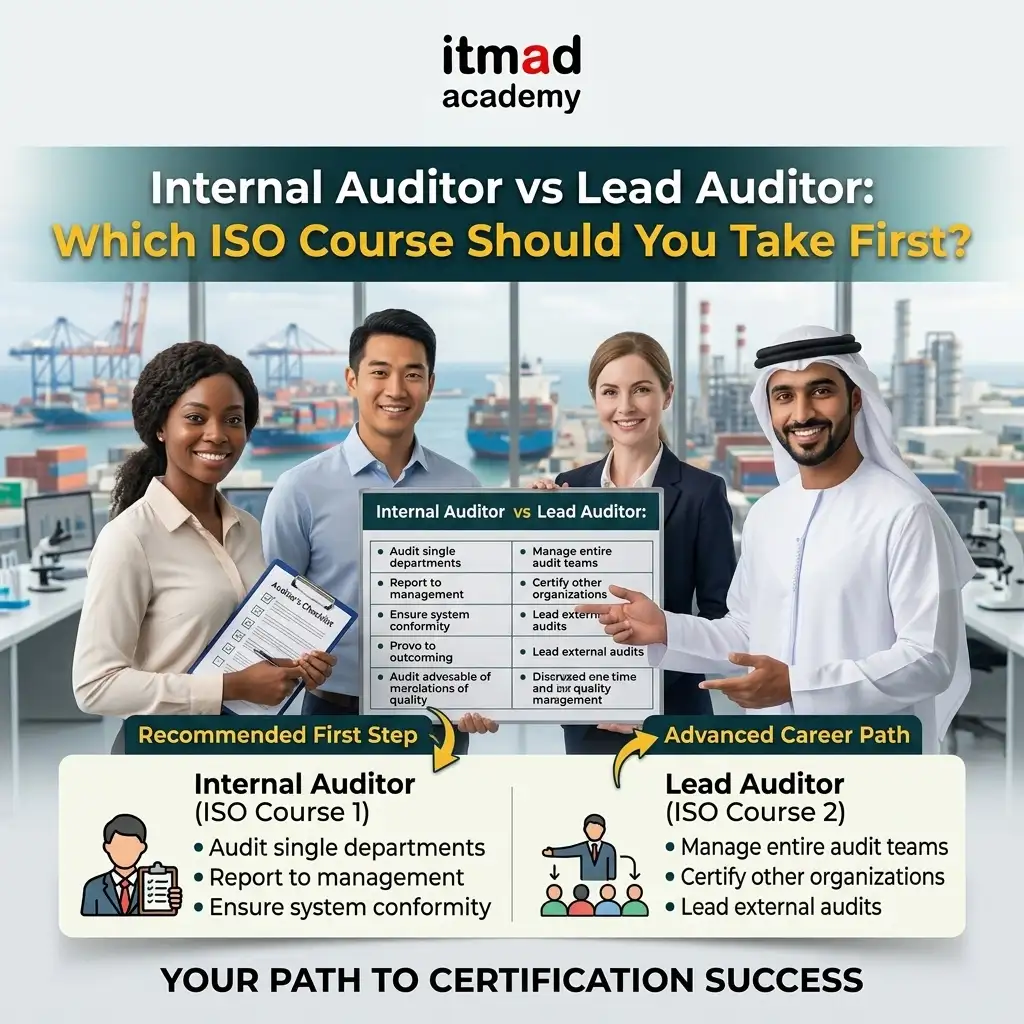
If you are new to auditing, take an internal auditor course first. It teaches you how to plan, perform and report an audit against an ISO standard, and it is the faster, lower-commitment way to build the skill. Choose a lead auditor course first only if you already have audit experience, or if your employer, client or role specifically requires you to lead audits and audit external parties. For most quality, HSE and compliance professionals in the GCC, the sensible path is internal auditor first, then lead auditor when your responsibilities grow. This guide explains the difference, how to decide, and what to check before you enrol.
The short answer
Use this as a first filter, then read the sections below to confirm it.
- Start with an internal auditor course if you are new to auditing, if you will audit your own organisation's processes, or if you want to learn the method before committing to a bigger programme. Browse the internal auditor courses.
- Start with a lead auditor course if you already audit, if your role involves leading audit teams or auditing suppliers and other external parties, or if your employer or client names a lead auditor credential. Browse the lead auditor courses.
- Not sure? Ask whoever will read your certificate which one they expect, then decide.
What an internal auditor does
An internal auditor checks whether your own organisation follows its management system and the ISO standard it is built on. Typical work includes:
- Planning and carrying out audits of internal processes
- Collecting and evaluating objective evidence
- Writing findings and nonconformity reports
- Following up corrective actions until they are closed
- Helping the organisation stay ready for external audits
Internal audits are expected by most ISO management system standards, which is why internal auditors are needed in almost every certified organisation.
What a lead auditor does
A lead auditor does the same core work and also takes responsibility for the whole audit. That usually means:
- Defining the audit objectives, scope and criteria
- Planning the audit and assigning work to the audit team
- Leading the opening and closing meetings
- Making the call on findings and resolving disagreements inside the team
- Writing and presenting the audit report
- Auditing suppliers, partners and other external organisations
The guidance most auditors work from is ISO 19011, which covers the principles of auditing and how to manage an audit programme. You can read about it on the official ISO page for ISO 19011.
Internal auditor vs lead auditor: the key differences
Scope
An internal auditor usually audits inside one organisation. A lead auditor is expected to handle internal audits, supplier audits and, in some roles, audits on behalf of a client or certification body.
Depth and time commitment
Lead auditor training goes deeper into planning, team leadership and reporting, so it takes longer. On our course pages, for example, the ISO 9001 internal auditor course is listed at 16 hours and the lead auditor course at 40 hours. Hours vary by standard, so check the page for the exact course you want.
Responsibility
An internal auditor is accountable for the quality of their own audit work. A lead auditor is accountable for the whole audit, including the team, the timeline and the conclusions.
Credential requirements
A course certificate shows that you completed training. A personal auditor certification or registration is a separate credential from a certification body and can carry its own experience criteria. Check which one your role needs before you pick a course.
How to decide
Your current role
- If you coordinate quality, HSE or compliance inside one site or company, internal auditor is usually the natural first step.
- If you already manage supplier audits, certification readiness or audit programmes, lead auditor may fit better.
What your employer or client asks for
Job descriptions, tender documents and supplier requirements often name the credential they want. If one does, that settles it. If you are unsure, ask the person who will review your credentials before you enrol. A short email now is far cheaper than repeating a course later.
Your audit experience
If you have never audited before, the internal auditor course gives you the method and the vocabulary at a manageable pace. If you have run audits for years and mainly need the formal lead credential, going straight to lead auditor can make sense.
Your timeline
Internal auditor courses are shorter, so they are easier to fit around a full-time job. If you expect to need the lead credential within the next year or so, plan both together so the second course builds on the first while the material is still fresh.
Common mistakes to avoid
- Choosing lead auditor because it sounds more senior. If your role only needs internal audits, you may be paying for depth you will not use yet.
- Treating a course certificate as a personal certification. They are different credentials with different requirements.
- Ignoring the standard and its edition. Several ISO standards are moving to new editions, so confirm the course covers the version your organisation audits against.
- Choosing by price alone. Check the course approval, the format and what the certificate actually states.
- Skipping the requirement check. Ask what your employer or client accepts before you pay for anything.
How the courses work at Itmad Academy
Itmad Academy offers both levels across many ISO standards. The courses are 100% online and self-paced, and Itmad Academy training is approved by Exemplar Global. On our course pages, the certificate is described as a digitally verifiable course completion certificate. You can see the approvals we hold on our accreditations page.
If you want a view from the certification-body side, you can also look at itmad Certification, an accredited certification body in the UAE.
Frequently asked questions
Can I skip the internal auditor course and go straight to lead auditor?
Often you can, but it depends on the entry requirements of the course and on what your employer expects. Read the course page, and if you have no audit experience, consider starting with internal auditor so the method is familiar before you lead anything.
Does a lead auditor course include internal auditor skills?
Lead auditor training typically builds on the same audit principles and adds planning, leading a team and reporting. Check the course page for the exact content of the course you are considering.
Which one is more recognised in the GCC?
Recognition depends on who is asking. Some employers and clients name a specific credential, and for them the named one is the right one. Where nothing is specified, both are credible routes for quality, HSE and compliance roles.
How long does each course take?
It depends on the standard and the level. On our course pages, the ISO 9001 internal auditor course is listed at 16 hours and the lead auditor course at 40 hours, and both are self-paced, so you study when it suits you. Check the page for the exact course.
Do I need audit experience before I enrol?
Training courses and personal certifications can have different requirements. The course page tells you what the course expects, and the certification body's own site tells you what its credential needs. Check both before you commit.
Your next step
Write down your role, what your employer or client expects and how much audit experience you have. Then pick the level that fits. When you are ready, browse our ISO auditor courses and choose the standard and level that suit you.