
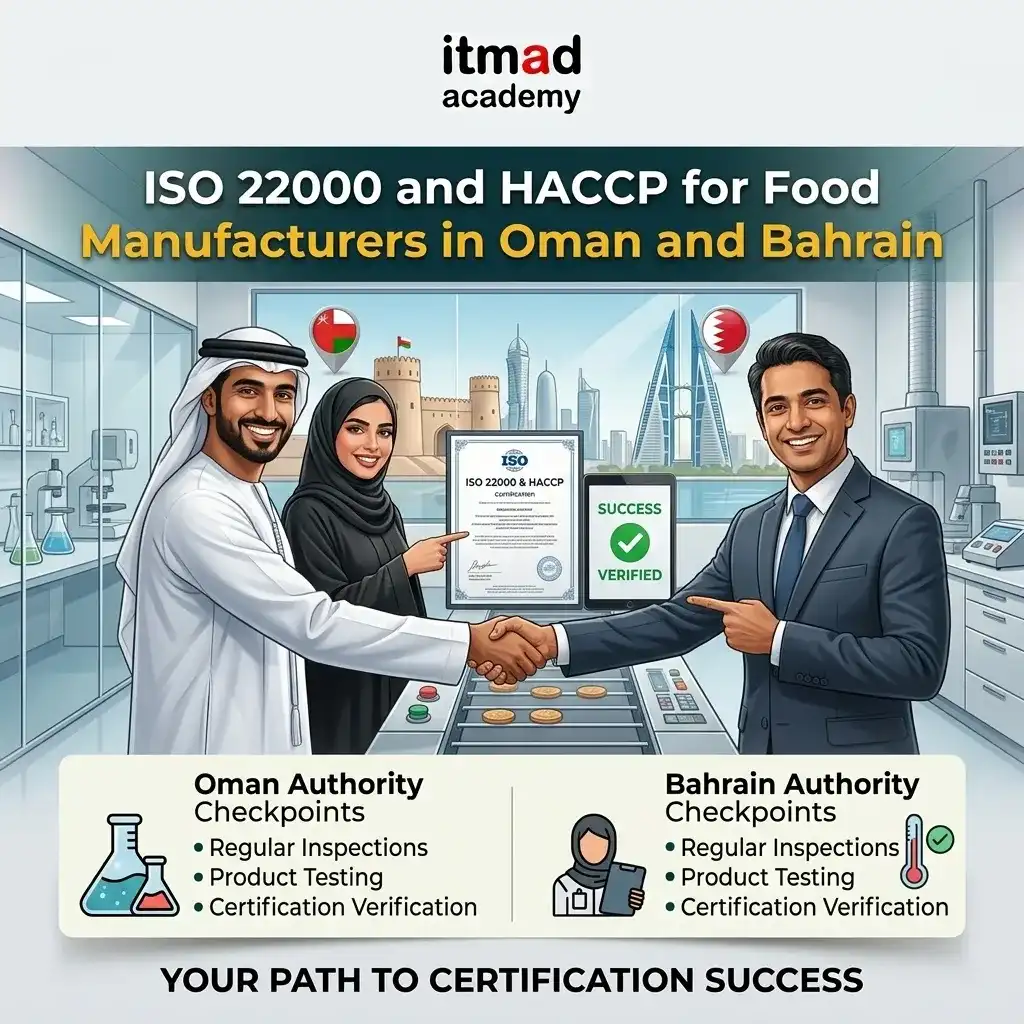
ISO 22000 and HACCP for Food Manufacturers in Oman and Bahrain
For food manufacturers in Oman and Bahrain, HACCP and ISO 22000 are not rivals. HACCP is the method for finding and controlling food safety hazards; ISO 22000 is the management system that builds that method into how your whole company runs, from policy and audits to supplier control. Most manufacturers start with a working HACCP plan and prerequisite programmes, then move to ISO 22000 certification when customers, tenders or export markets ask for it. Your first step is to confirm what your customers and the authorities in your country expect. This guide explains how the two fit together, what certification involves, and how to train your team.
HACCP and ISO 22000 in plain terms
What HACCP does
HACCP stands for Hazard Analysis and Critical Control Points. It is a structured way to stop food safety problems before they reach the customer. In practice it means you:
- Identify the biological, chemical and physical hazards in each step of your process
- Decide which steps are critical control points
- Set limits, monitor them and record the results
- Define what happens when a limit is missed
- Verify that the whole plan works and keep the records
HACCP is described in the Codex Alimentarius food hygiene texts and is used worldwide.
What ISO 22000 adds
ISO 22000:2018 sets requirements for a food safety management system for any organisation in the food chain. It builds the HACCP principles into a wider system, so food safety is managed like any other part of the business. That usually means:
- Leadership commitment and a food safety policy
- Prerequisite programmes such as hygiene, cleaning and pest control
- Clear communication with suppliers, customers and regulators
- Internal audits and management review
- Continual improvement based on evidence
You can read the standard's scope on the official ISO page for ISO 22000:2018. The page also notes that a revision is in development, so check the current edition before you plan a transition.
How they fit together
Think of HACCP as the engine and ISO 22000 as the whole vehicle. HACCP controls the hazards. ISO 22000 makes sure the controls are owned, resourced, audited and improved. A manufacturer can use HACCP without ISO 22000, but a company certified to ISO 22000 will have HACCP inside it.
Which one do you need first?
Use this as a first filter and then confirm it with your customers.
- Start with HACCP if you are building your first food safety plan, if your customers only ask for a HACCP-based system, or if your team is new to food safety.
- Move to ISO 22000 if you supply large buyers, tenders or export markets that ask for a certified management system, or if you want one system that covers food safety end to end.
- Check the exact scheme. Some customers name a specific scheme built on ISO 22000, so ask what they will accept before you invest.
Two routes: certify your company and train your people
Many manufacturers mix the two up. They are separate jobs, and most companies need both.
Route 1: certification of your company
ISO 22000 certification is awarded to your organisation by a certification body after an audit of your food safety management system. The certificate belongs to the company, not to an individual. When you choose a certification body, check that:
- It is accredited for the scheme you need, and the accreditation body is named
- The scope covers your type of food business
- It serves your country and can audit your site
Ask each certification body you shortlist to confirm in writing that its accreditation scope covers ISO 22000 for your type of food business, and that it can audit your site in Oman or Bahrain. Scope differs between bodies, and it is confirmed by the certification body, not by this article.
Route 2: training your people
Training is how your team learns to build, run and audit the system. It does not certify your company, but it gives you the people who can get the company ready. Itmad Academy offers courses that are 100% online and self-paced:
- ISO 22000: foundation (6 hours), internal auditor (16 hours), lead auditor (40 hours) and implementer (24 hours). See the ISO 22000 courses.
- HACCP: foundation (6 hours), internal auditor (16 hours) and implementer (24 hours). See the HACCP courses.
Hours are as listed on our course pages. The internal auditor and lead auditor courses are listed with Exemplar Global approval, and you can see the approvals we hold on our accreditations page.
Steps to get ready for ISO 22000
- Confirm the requirement. Ask your customers and check the expectations in your country before you decide on a scheme.
- Map your process. Draw each step from receiving to dispatch and list the hazards at each one.
- Build the prerequisite programmes. Hygiene, cleaning, pest control, supplier approval and traceability come first.
- Write and run the HACCP plan. Keep the monitoring records so you can show the system working.
- Audit yourself. Run an internal audit and a management review before you invite a certification body in.
- Close the gaps, then book the audit. Fix findings first, then ask the certification body for its audit stages and timeline.
Training path by role
Production and QA supervisors
Start with the HACCP foundation course, then the ISO 22000 foundation course. Together they give a shared vocabulary for the whole team in about a dozen hours of study.
Internal auditors
The ISO 22000 internal auditor and HACCP internal auditor courses teach you to audit the system and the HACCP plan. These are the people your certification body will expect to see running internal audits.
Lead auditors and consultants
The ISO 22000 lead auditor course is for people who lead audits or advise several sites. There is no separate HACCP lead auditor course on our site, so the ISO 22000 lead course is the senior route.
Implementers
The ISO 22000 and HACCP implementer courses suit the people who will build the system, write the procedures and prepare the company for audit.
Common mistakes to avoid
- Treating a HACCP plan as a full system. Without prerequisite programmes, training and audits, the plan sits on paper.
- Training one person only. If that person leaves, the knowledge leaves too. Train a small team.
- Confusing training with certification. A course certificate shows a person completed training. Company certification comes from a certification body audit.
- Booking the certification audit too early. Certification bodies look for records that show the system working, so run it first.
- Ignoring the current edition. Check which version of ISO 22000 your customers expect.
What to check locally in Oman and Bahrain
Requirements differ by country, product category and customer, and they change. Before you commit, check:
- What the competent food authority in your country expects for your product category
- What your biggest customers and distributors require in their supplier terms
- What your export markets ask for if you ship outside the GCC
- Whether any tender or licence you hold names a specific scheme
Frequently asked questions
Is HACCP part of ISO 22000?
Yes. ISO 22000 builds the HACCP principles into a wider food safety management system. HACCP on its own is a method for controlling hazards, while ISO 22000 adds the management system around it.
Do I need ISO 22000 certification to sell food in Oman or Bahrain?
It depends on your product category, your customers and the rules in each country. Check with the competent authority and with your buyers before you decide.
Can my team train online?
Yes. Our ISO 22000 and HACCP courses are 100% online and self-paced. Training builds your team's skills, but certifying your company still needs an audit by a certification body.
Which course should my QA team take first?
If they are new to food safety, start with the HACCP foundation course. If they will audit the system, the internal auditor courses are the next step.
What is the difference between certifying the company and training the team?
Certification is an audit of your organisation's system by a certification body. Training is individual learning for the people who build and audit that system. Most manufacturers need both.
Your next step
List what your customers and the authorities in your country require, then decide your route: company certification, team training, or both. When you are ready to train, browse our ISO and HACCP courses or start from the standards hub.