
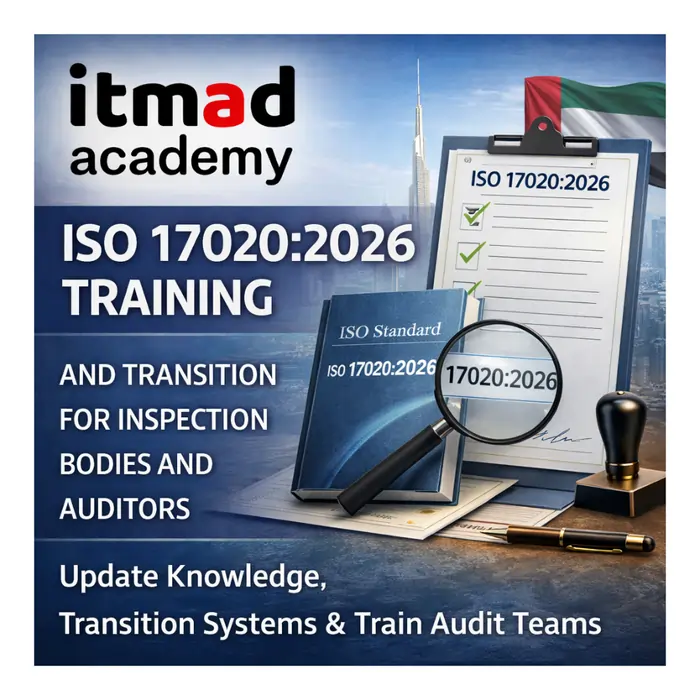
ISO 17020:2026 Training and Transition for Inspection Bodies and Auditors
The publication of ISO 17020:2026 introduces a defined progression in the regulatory and operational expectations placed on inspection bodies worldwide. As a standard governing the competence, impartiality, and consistency of inspection activities, ISO 17020 holds a central role in industries where verification, safety, and compliance are critical.
The updated version does not merely revise clauses—it reinforces how inspection bodies are expected to operate in increasingly complex and accountability-driven environments. For organizations currently accredited or operating under ISO 17020 frameworks, and for professionals responsible for inspection and audit functions, the release marks the beginning of a structured transition phase.
ISO 17020:2026 – Direction and Industry Context
The revised ISO 17020 conformity assessment standard reflects a broader shift across conformity assessment standards—moving away from procedural compliance toward demonstrable competence and consistent decision-making.
Key areas of focus in ISO 17020:2026 include:
• Strengthened requirements for impartiality and independence
• Greater clarity in inspection methods and reporting outputs
• Enhanced competence expectations for inspection personnel
• Improved consistency in technical judgments and conclusions
These changes are not isolated—they align with global regulatory expectations and increasing scrutiny on inspection outcomes across sectors such as construction, oil & gas, manufacturing, and infrastructure.
What the Update Means for Inspection Bodies
For inspection bodies like Itmad Certification Services LLC
Organizations must now evaluate whether their existing systems:
• Accurately reflect updated requirements for impartiality
• Ensure competence across all inspection personnel
• Maintain consistency in inspection reporting and decisions
• Demonstrate clear control over inspection methodologies
The transition is not limited to revising documentation. Certification and accreditation bodies will assess whether the updated standard is effectively implemented in practice, particularly during audits and surveillance activities.
Inspection bodies that approach this update as a procedural adjustment may face misalignment during assessments.
Transition Requirements – A Controlled Process
The shift to ISO 17020:2026 will follow a defined transition timeline, during which inspection bodies are expected to align their systems with the revised requirements. A structured transition typically involves:
1. Gap Analysis
A detailed comparison between current practices and updated clauses to identify areas requiring change.
2. System Alignment
Updating procedures, inspection methods, and documentation to reflect revised expectations.
3. Internal Audit Adjustment
Ensuring that internal audits are conducted against ISO 17020:2026 rather than legacy interpretations.
4. Competence Development
Training personnel to understand and apply updated requirements effectively.
5. Certification Readiness
Preparing for transition audits conducted by certification or accreditation bodies.
Each of these steps requires coordination across technical, operational, and compliance teams.
The Critical Role of Auditors and Inspection Personnel
ISO 17020:2026 places significant emphasis on competence—not only at the organizational level, but at the individual level.
Inspection engineers, technical staff, and auditors must be capable of:
• Interpreting updated requirements accurately
• Applying consistent inspection methodologies
• Producing clear and reliable inspection reports
• Supporting defensible technical decisions
For internal auditors and implementers, the update introduces a direct requirement to align audit practices with the revised standard.
Without updated competence:
• Audit findings may be inconsistent
• Non-conformities may be misinterpreted
• Certification outcomes may be affected
This makes auditor readiness a central component of transition success.
ISO 17020:2026 Training – A Practical Requirement
An ISO 17020:2026 training and transition for inspection bodies approach is essential for maintaining both operational control and certification continuity.
Training serves multiple purposes:
For organizations:
• Ensures teams understand updated requirements
• Supports accurate system implementation
• Reduces risk during certification audits
For professionals:
• Maintains relevance under the updated standard
• Enhances audit and inspection capability
• Strengthens professional credibility
Training is not an optional enhancement—it is a necessary step in aligning people with the updated system.
Structured Learning Through Itmad Academy
Itmad Academy provides ISO 17020:2026 training programs designed specifically for inspection bodies, auditors, and technical professionals.
The programs are structured to support:
• Internal auditors are responsible for compliance checks
• Inspection personnel involved in technical evaluations
• Organizations preparing for ISO 17020 transition
Training formats include:
• Awareness and foundation courses
• Internal auditor programs
• Implementer Training courses
• Transition-focused modules aligned with ISO 17020:2026
Delivered through a 100% self-paced model, the training enables professionals to upgrade their knowledge without disrupting operational responsibilities.
Integration with Certification and Compliance
Training becomes significantly more effective when aligned with certification requirements.
Through Itmad Certification Services LLC, inspection bodies can ensure that:
• Training outcomes reflect real audit expectations
• Transition activities align with certification requirements
• Systems are prepared for assessment under ISO 17020:2026
Organizations may also opt for on-site or customized training sessions to address specific industry or operational needs.
This integrated approach reduces uncertainty and ensures a controlled transition process.
Strategic Advantage of Early Action
While transition timelines provide a structured window, the timing of action determines the quality of outcomes.
Inspection bodies that act early benefit from:
• Distributed workload across transition phases
• Improved internal alignment
• Stronger audit readiness
• Reduced compliance risk
Delayed action often results in:
• Compressed implementation timelines
• Increased audit pressure
• Higher likelihood of non-conformities
The difference lies not in capability, but in preparedness.
Positioning for the Updated Standard
ISO 17020:2026 represents a continued evolution in how inspection bodies are evaluated—placing greater emphasis on competence, consistency, and accountability.
For organizations, this is an opportunity to strengthen operational maturity.
For professionals, it is a requirement to remain aligned with current standards.
The transition demands a structured response—combining system updates, personnel training, and certification alignment.
The release of ISO 17020:2026 marks a clear shift in expectations for inspection bodies and audit professionals.
It is not a change that can be managed passively. It requires:
• Understanding the updated requirements
• Aligning internal systems and processes
• Ensuring competence across teams
An ISO 17020:2026 training and transition for inspection bodies approach provides the foundation for managing this shift with clarity and control.
Organizations that act early and invest in structured preparation will navigate the transition with confidence—while maintaining the integrity of their certification and inspection activities.