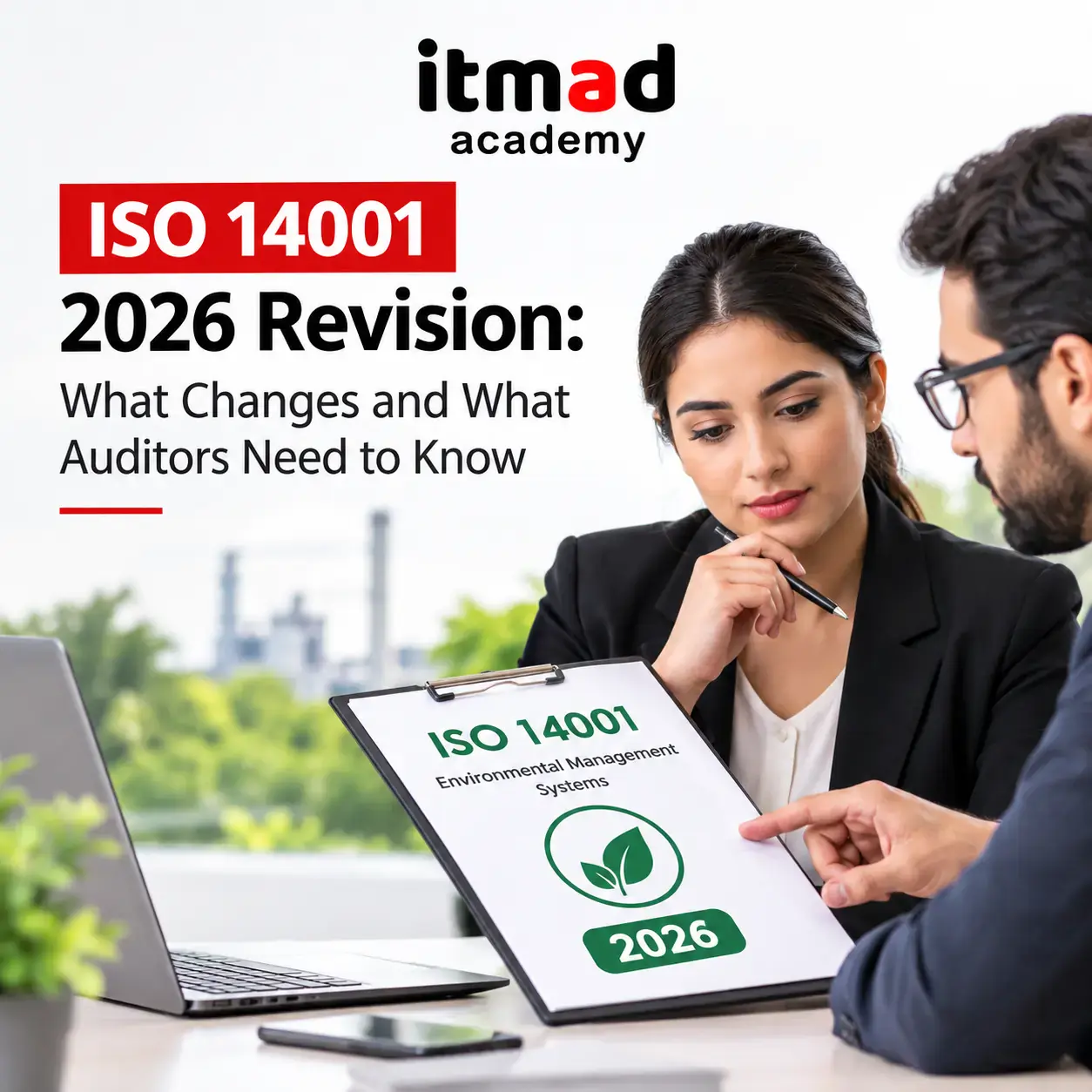

ISO 14001:2026 Training Course – What the New Standard Means for Certified Organizations
ISO 14001:2026 Training Course and What the New Standard Means for Organizations and Auditors
The publication of ISO 14001:2026 marks a formal update to the global framework for environmental management systems, introducing refinements that will directly affect certified organizations, audit practices, and professional competence requirements.
While the structure of the ISO 14001 Environmental Management System remains aligned with its previous edition, the updated version reflects a broader shift in how environmental performance is evaluated—from procedural compliance to measurable, context-driven outcomes.
For organizations operating under certification and for professionals responsible for maintaining those systems, this update is not theoretical. It requires awareness, interpretation, and controlled implementation.
A Standard Update with Operational Implications
ISO 14001:2026 is not a disruptive rewrite, but it is not a minor editorial revision either. The update introduces clarifications and enhancements that strengthen how organizations are expected to interpret environmental risks, manage external influences, and demonstrate accountability.
The direction is clear: environmental management systems must be more integrated into business operations, more responsive to evolving environmental conditions, and more demonstrable in terms of performance.
This raises the bar—not through complexity, but through expectation.
What This Means for Certified Organizations
For organizations already certified, the release of ISO 14001:2026 initiates a transition cycle. Certification will continue, but only if systems are updated in line with the revised requirements.
The immediate considerations for organizations include:
• Reviewing environmental aspects in light of updated context expectations
• Aligning risk and opportunity assessments with broader environmental factors
• Ensuring internal audit programs reflect the revised standard
• Updating management review inputs to support more informed decision-making
The critical point is this: certification bodies will not assess documentation alone—they will assess whether the system reflects the updated intent of the standard in practice.
Organizations that approach this as a procedural update risk misalignment during audits.
Impact on Internal and Lead Auditors
The release of ISO 14001:2026 has a direct and immediate effect on auditors.
Internal auditors and lead auditors are expected to interpret and apply the updated standard during audits. This requires more than familiarity—it requires alignment with how certification bodies will evaluate compliance under the new version.
Without updated knowledge, audit functions become inconsistent. Findings may be incomplete, misaligned, or insufficient to support certification decisions.
For organizations that rely on internal audits as a core control mechanism, auditor competence becomes a critical factor in maintaining system credibility.
Transition Is Structured, But Time-Sensitive
As with previous ISO revisions, a defined transition period will apply. This provides organizations with time to update systems, train teams, and align with certification requirements.
However, transition timelines often create a false sense of flexibility.
In practice, organizations that delay preparation tend to compress their transition into late-stage activity—resulting in:
• Increased audit pressure
• Higher likelihood of non-conformities
• Disruption to certification cycles
A structured approach—starting early—remains the most effective strategy.
Where Training Becomes Critical
The common point of failure during standard updates is not effort—it is interpretation.
Organizations may update procedures, but without a clear understanding of what has changed and how it is assessed, gaps remain.
This is where an ISO 14001:2026 training course becomes a practical requirement.
For organizations, training ensures that internal teams understand how to interpret and apply the updated requirements.
For auditors, it ensures that audit activities remain aligned with certification expectations.
Training is not an additional step—it is the foundation for a controlled transition.
Structured Learning Through Itmad Academy
Itmad Academy provides ISO 14001:2026 training course programs designed to address both organizational and professional requirements.
The training is developed to support:
• Certified organizations preparing for transition
• Internal auditors aligning with updated audit criteria
• Lead auditors maintaining professional relevance under the new standard
Delivered through a 100% self-paced format, the courses allow professionals to upgrade their knowledge without operational disruption, while maintaining focus on real audit and compliance scenarios rather than theoretical overviews.
Alignment with Certification and Implementation
Training alone does not complete the transition—it must align with certification requirements.
Through Itmad Certification Services LLC, organizations can connect training outcomes with certification expectations, ensuring that:
• System updates reflect actual audit criteria
• Teams are prepared for transition audits
• Implementation aligns with certification body evaluation
Additionally, organizations may opt for on-site or one-to-one training sessions to address specific operational or industry requirements.
This combined approach ensures that training and certification function as a single, coordinated process.
Market Direction and Early Adoption
The update to ISO 14001 reflects broader global priorities—particularly around environmental accountability, sustainability integration, and risk transparency.
Organizations that respond early to ISO 14001:2026 will benefit from:
• Controlled and predictable transition cycles
• Stronger audit outcomes
• Improved positioning with regulators and stakeholders
• Enhanced internal system maturity
Those that delay will not lack capability—they will lack time.
A Measured Response to ISO 14001:2026
The release of ISO 14001:2026 is a defined point of change for certified organizations and audit professionals.
It does not require urgency without direction—but it does require action with clarity.
Understanding the update, aligning internal competence, and preparing systems in a structured manner will determine how effectively organizations navigate this transition.
An ISO 14001:2026 training course is the starting point—not as a formality, but as a necessary step in maintaining certification integrity and operational control.
Frequent Asked Questions (FAQs)
ISO 14001 training courses help individuals and organizations understand and implement environmental management systems based on ISO 14001 standards, covering requirements, compliance, and auditing practices.
You can enroll in ISO 14001 training courses online through accredited training providers offering self-paced or instructor-led programs, allowing flexible learning from anywhere.
ISO 14001 training is suitable for environmental managers, compliance officers, internal auditors, and professionals responsible for implementing or maintaining an environmental management system.
The ISO 14001 internal auditor course trains professionals to conduct internal audits, identify non-conformities, and ensure compliance with environmental management system requirements.
ISO 14001 EMS Lead Auditor Training provides advanced knowledge on audit planning, execution, reporting, and leading audit teams according to ISO 14001 and international auditing standards.
The cost of ISO 14001 training in the UAE varies depending on course level, provider, and format. Online courses are generally more affordable, while lead auditor programs require higher investment.
Yes, ISO 14001 training courses online are widely available in the UAE, allowing professionals to learn at their own pace without attending physical classes.
ISO 14001:2026 training focuses on updated requirements, enhanced environmental performance expectations, and alignment with evolving sustainability and regulatory frameworks.