
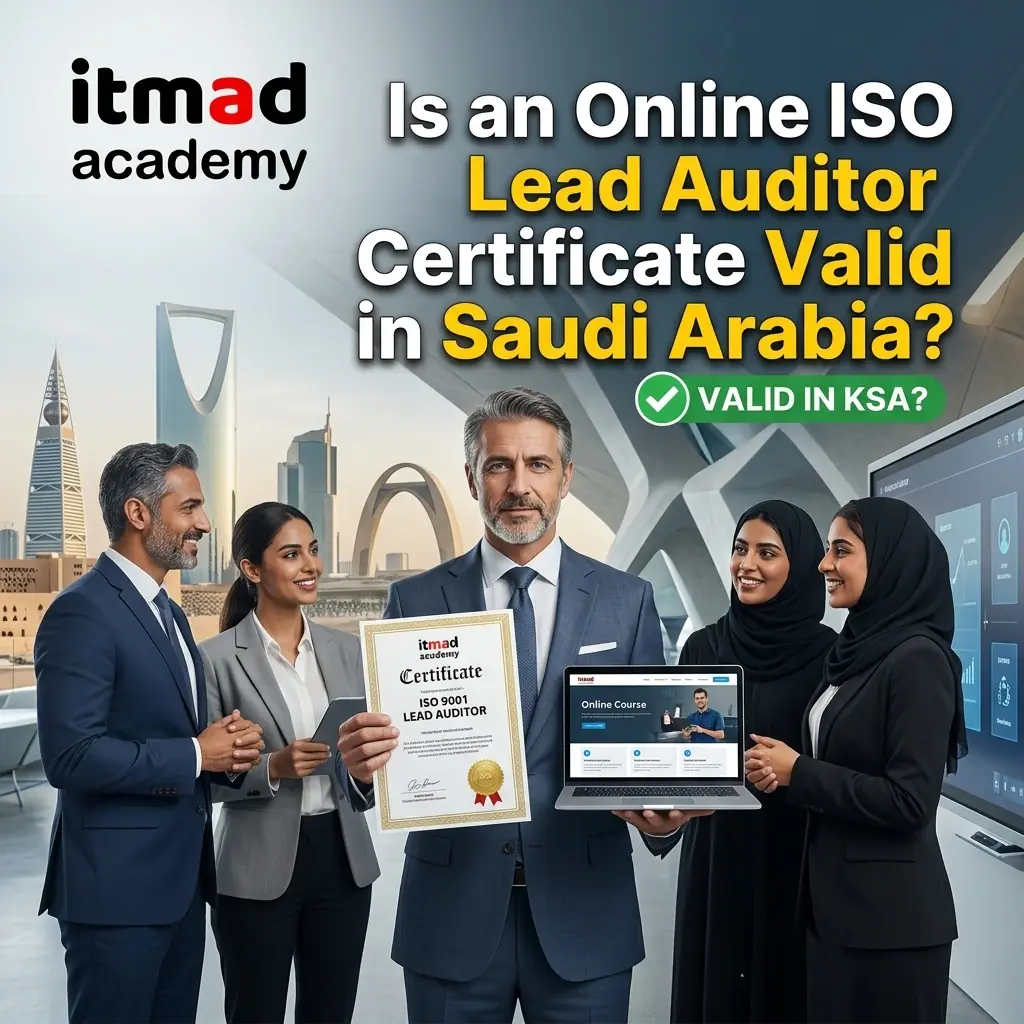
Is an Online ISO Lead Auditor Certificate Valid in Saudi Arabia?
An online ISO lead auditor certificate can be valid in Saudi Arabia, but whether it is accepted has little to do with the fact that you studied online. Acceptance depends on three things: who accredited the course, whether the training meets the scheme your employer or client recognises, and whether you also hold, or are working towards, a personal auditor certification. Check those three points before you enrol, and a well-chosen online course can be a sound investment for quality, HSE and compliance careers across Saudi Arabia and the wider GCC.
This guide explains how the pieces fit together, what to verify, and how to avoid paying for a certificate that nobody asks for.
What "valid" really means for a lead auditor certificate
Professionals often ask whether a certificate is "valid" as if there were one official stamp. There is not. ISO writes management system standards such as ISO 9001, ISO 14001 and ISO 45001, but ISO does not certify individual auditors and does not issue lead auditor licences. What exists instead is a set of independent arrangements, and the word "valid" depends on which of them the person asking cares about.
A course certificate is not a personal auditor certification
These two documents are often confused:
- Course completion certificate. Proof that you completed a training course and passed its assessment. It shows what you learned.
- Personal auditor certification. Granted by a certification scheme after you meet its criteria. These typically combine approved training with relevant education, work experience and audit experience, and some require ongoing professional development to maintain.
When an employer writes "ISO 9001 Lead Auditor certificate required" in a job advertisement, they may mean either one. It is worth asking which, because the answer changes what you need to buy.
Who decides whether it is accepted
Acceptance is decided by the party that relies on the certificate:
- Your employer decides whether the certificate meets the job requirement.
- A client or a tender may name the auditor qualifications it expects for supplier or second-party audits.
- A certification body that audits organisations for certification sets its own competence criteria for the auditors it uses, working under the requirements of ISO/IEC 17021-1 and drawing on ISO 19011 guidance on auditor competence and evaluation.
No outside website can tell you in advance what each of these will accept. Only they can, so the sensible approach is to ask them.
Does studying online change anything?
For most employers and schemes, what matters is the quality and recognition of the course, not the room it was delivered in. A well-run online lead auditor course has the same learning objectives as a classroom course: understanding the standard, planning and conducting an audit, reporting findings and following up on corrective actions. What differs is the delivery.
That said, "online" covers a wide range. Some courses are live virtual classrooms, others are fully self-paced, and a few are little more than recorded videos with a quiz. Look at the substance:
- Is the course accredited or approved by a recognised body, and can you check that yourself?
- Does it include audit practice, such as case studies and practical exercises, rather than only reading?
- Is there a proper final assessment, not just attendance?
- Does the certificate name the course, the standard and the training hours?
Requirements change from scheme to scheme and from year to year, so confirm the current rules of the scheme you intend to certify under. Do not rely on an old forum answer.
Four checks before you enrol
These steps take a few minutes and prevent most disappointments.
- Ask the requirement-setter first. Email your employer, client or target certification body and ask, in writing, what they accept: a course certificate, a personal certification, or both, and from which schemes.
- Verify the accreditation yourself. Do not rely on a logo on a sales page. Check the course approval directly with the accrediting body or in the provider's published approvals.
- Match the standard and the version. A lead auditor course is specific to a standard, such as ISO 9001, ISO 14001 or ISO 45001, and the version matters. Choose the one your organisation is actually working towards.
- Plan for the personal certification. If you want to be recognised as a certified auditor, find out the scheme's experience and education criteria now, so you can start recording audits while you study.
What this means for professionals in Saudi Arabia and the GCC
Quality, HSE and compliance teams in the Gulf often work alongside international clients, multinational contractors and regional stakeholders. Credentials tied to an international scheme are easier to explain to all of them, which is a good reason to prefer training backed by such a scheme where you can.
The practical advice is the same wherever you work in the region. Treat any promise of "valid everywhere" with caution, including ours. Validity is always relative to who is asking, so ask them, and keep your training records, assessment results and certificates together so you can show them when needed.
Choosing a course: an ISO 9001 example
If your goal is to audit quality management systems, an ISO 9001 lead auditor course is the usual starting point. Itmad Academy is accredited by Exemplar Global and delivers its ISO training 100% online and self-paced, so you can study around shift patterns and site visits.
You can see every standard we cover on the ISO standards page, then compare the foundation, internal auditor, lead auditor and implementer levels for each one. Whatever you choose, apply the four checks above before you pay.
Frequently asked questions
Is an online lead auditor course accepted by employers in Saudi Arabia?
Requirements differ. Some employers focus on the accreditation of the course, while others specify a particular scheme or also ask for a personal certification. Ask the employer or client what they require, in writing, before you enrol.
Is a course completion certificate the same as being a certified lead auditor?
No. A course certificate shows that you completed training. Becoming a certified auditor is a separate step with a certification scheme, which usually looks at your education, work experience and audit experience as well as your training.
Do I need audit experience to be certified as a lead auditor?
Personal certification schemes usually ask for audit experience in addition to training, so check the criteria of the scheme you are aiming for and start logging audits early. Entry requirements for the course itself vary by provider, so read the course page.
How can I check that a course is genuinely accredited?
Do not rely on a logo alone. Check the course with the accrediting body or in the provider's published approvals, and ask the provider for the approval details if they are not clear.
Can I use my certificate to work for a certification body?
Certification bodies set their own competence criteria for the auditors they use, based on the requirements of ISO/IEC 17021-1, and a lead auditor course is normally one part of meeting them. Contact the certification body you are interested in and ask what they require.
Your next step
If you are ready to build auditing skills you can show to employers across the GCC, start with a course whose accreditation you can verify. Explore the ISO 9001:2026 Lead Auditor course and apply the four checks above before you enrol.