

Accredited vs Non Accredited ISO Certification: Understanding Recognition, Compliance, and Business Risk
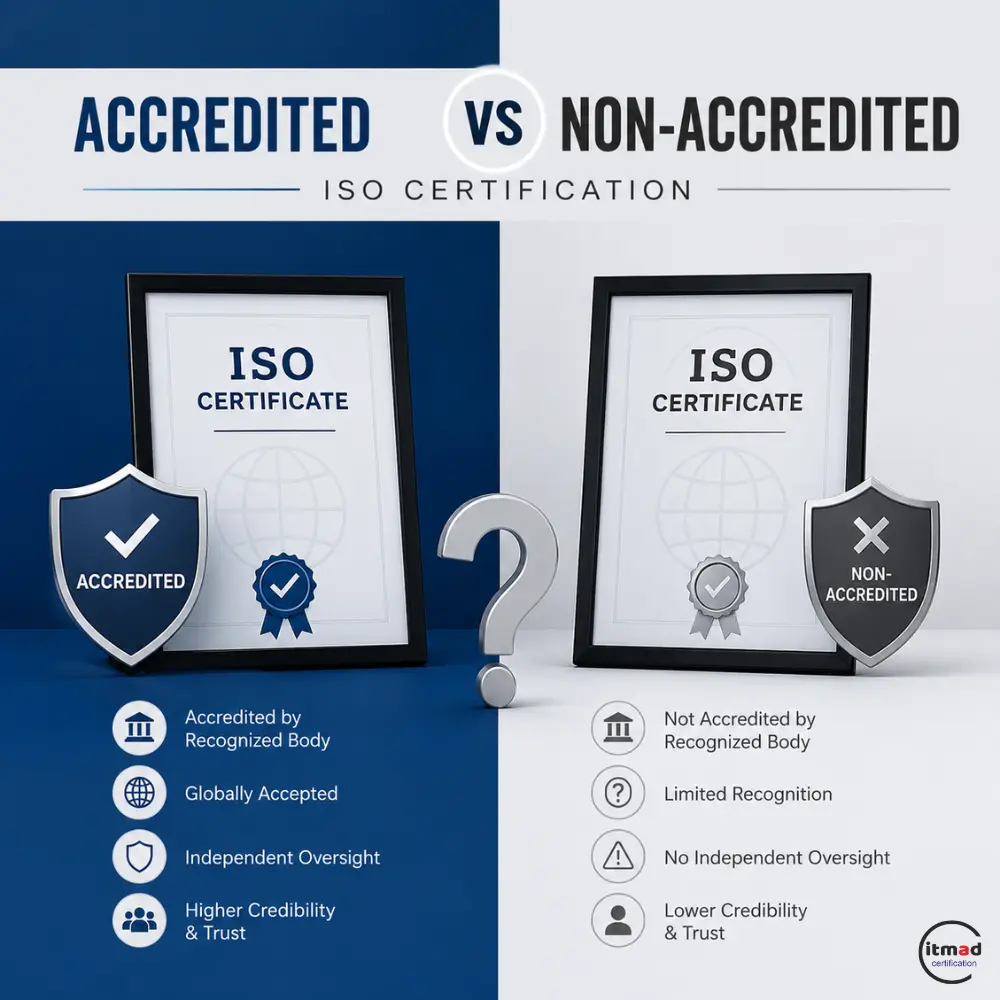
Accredited vs Non-Accredited ISO Certification: What Organizations Need to Know Before Choosing a Certification Body
The ISO certification market has expanded significantly over the last decade. Today, organizations seeking certification can choose from hundreds of certification providers offering various audit programs, recognition schemes, and pricing models.
During this process, one question appears repeatedly among business owners, procurement teams, consultants, and compliance managers:
What is the difference between accredited and non-accredited ISO certification?
The answer is more important than many organizations realize.
While both certification routes may involve audits against the same ISO standard, the level of recognition, oversight, and acceptance can vary considerably depending on how the certification has been issued.
Understanding these differences helps organizations make informed decisions, avoid unnecessary costs, and select a certification route that aligns with their operational, contractual, and regulatory requirements.
Why Accreditation Matters in ISO Certification
To understand the difference between accredited vs. non-accredited ISO certification, it is important to first understand the role of accreditation.
An accreditation body evaluates and approves certification bodies against internationally recognized requirements. The purpose is to ensure that certification bodies conduct audits competently, consistently, and impartially.
In simple terms:
A certification body audits organizations.
An accreditation body audits the certification body.
This additional layer of oversight provides confidence that certification decisions are based on internationally accepted practices rather than internal business decisions alone.
What Is Accredited ISO Certification?
Accredited ISO certification is issued by a certification body that operates under the oversight of a recognized accreditation authority.
The certification body must demonstrate competence, impartiality, auditor qualification management, and compliance with international accreditation requirements.
For organizations, this provides greater confidence that certification activities are independently verified and regularly monitored.
Accredited certification is commonly required for:
For many organizations, accredited certification represents the highest level of external recognition available within the ISO certification framework.
What is Non-Accredited ISO Certification?
Non-accredited ISO certification is issued by a certification body that is not operating under a recognized accreditation scheme for the specific certification activity.
This does not automatically mean the certification is invalid or that the audit lacks value.
In many situations, non-accredited certification may still provide:
However, acceptance depends largely on the expectations of customers, regulators, procurement teams, and project owners.
A non-accredited certificate that is accepted by one client may not necessarily be accepted by another.
This is why organizations should carefully assess their objectives before selecting a certification route.
Accredited vs Non-Accredited ISO Certification: The Practical Difference
From an implementation perspective, organizations often build similar management systems regardless of which certification route they pursue.
The major difference typically lies in recognition and acceptance.
An accredited certification generally provides broader acceptance because the certification body itself has been independently evaluated by an accreditation authority.
A non-accredited certification may still demonstrate management system implementation, but acceptance depends on the specific market, customer, or regulatory environment involved.
The key question is not which option is cheaper.
The key question is:
Who needs to recognize your certificate?
When Accredited Certification Is Usually Preferred
Organizations should strongly consider accredited certification when:
In these situations, selecting accredited certification from the beginning can help avoid future re-certification costs and project delays.
When Non-Accredited Certification May Be Suitable
There are also situations where non-accredited certification can be a practical choice.
Examples include:
The suitability ultimately depends on stakeholder expectations rather than the certificate itself.
The UAE Perspective on Accreditation
Within the UAE, awareness regarding certification credibility has increased substantially over recent years.
Many organizations now actively verify:
This trend has been driven by increasingly sophisticated procurement processes and stronger compliance expectations across industries.
As a result, organizations pursuing ISO certification should evaluate not only the certificate itself but also how the certification will be viewed by customers, regulators, consultants, and project owners.
How to Verify an ISO Certification
A common misconception is that all ISO certificates carry the same level of recognition.
Before accepting any certification claim, organizations should verify:
Verification helps reduce procurement risks and ensures confidence in supplier certification claims.
Choosing the Right Certification Partner
The decision should not be based solely on price.
Organizations should evaluate:
- Auditor competence
- Industry experience
- Certification scope
- Customer support
- Recognition requirements
- Accreditation needs
- Long-term business objectives
A certification body that understands both accredited and non-accredited certification pathways can often help organizations identify the most appropriate route based on their actual business requirements rather than a generic recommendation.
A Growing Shift Toward Informed Certification Decisions
The market is becoming more educated.
Today, organizations are increasingly asking:
These are the right questions.
Certification should not be viewed as simply obtaining a certificate. It should be viewed as obtaining recognition that aligns with business objectives and stakeholder expectations.
Conclusion
The discussion around accredited vs non-accredited ISO certification is not about determining which option is universally better. It is about determining which option is appropriate for a particular organization, market, or contractual requirement.
Accredited certification generally provides broader recognition and stronger external confidence, while non-accredited certification may still offer value in specific circumstances where accreditation is not required.
The most effective approach is to assess customer expectations, regulatory obligations, tender requirements, and long-term business goals before selecting a certification route.
Organizations that make informed certification decisions are far more likely to maximize the value of their investment and avoid costly adjustments later.